
In 1923, Lawson Brainerd was a ranger in the Tahoe National Forest, dispatched from the Sierraville Ranger Station. The work consisted mostly of putting out forest fires, building telephone lines, and policing a number of logging operations who had minimal regard for government rules and regulations. All of this was done on horseback, mostly traversing the mountains alone. There were no roads except those built by the logging companies. I imagine he must have known the mountains northwest of Lake Tahoe like the back of his hand. That summer, he set up camp in a meadow near Little Truckee Summit, where the horses had room to graze. His wedding day was approaching, and he set about building a proper home to welcome his new bride:
For our love-next I selected a little flat promontory overlooking the meadow where Buck and Cassy were dozing away the days. The office in Nevada City had sent me a 10′ x 12′ tent. There was an old abandoned logging camp across the meadow about a mile from the site and at stack times I would take one or both of the horses to the logging camp and after scavenging a load of lumber would drag it to our location. With no carpentering skill I started to bunch together a platform and frame for a tent. It looked like it had been supervised by a drunk pack rat but was “hell for strong.” Our furniture was orange and apple crates. Bed was a wooden frame with 1″x12″ boards for springs, mattress was fir, pine, and cedar boughs, smelled good. Sanitary facilities were a hole dug in the ground with a pole across for a seat. Four upright poles with burlap around them gave privacy; no top. When it rained or snowed, the pole was not a joy to sit on and no one loitered. Our water system was a nice, cold spring about the same distance in the other direction, all equipped with a dipper made from a coffee can and a bucket.

On May 16th, 2023, my great-grandparents were married, on the same day as my great-grandmother Helen graduated from UC Berkeley. I have a little engraved copper plate that commemorates the date. Lawson’s unexpected adventure as he departed for Berkeley is the kind of story that has been told so many times the details start to morph, but here is his original version:
The day I was to grab the logging train to Verdi for the trip to Berkeley, I rushed down to put the tent on the frame. Nyae Matra, sainted mother of Buddha!! the tent’s actual measurement was 9′ x 11′. It bowed its neck and refused to go over the frame. Reducing a 10’x12′ tent frame to 9’x11′ was a sneaky challenge. Lucky for me I could use an axe. I smote, hewed, hacked, and chopped, and by Herculean efforts at last got the tent over the frame only to find that the tent was riddled with holes. Time was of the essence, and I knew that the conductor on the logging train didn’t give a quid of snuff whether I got married or not. I piled everything that shouldn’t get wet in the middle of the tent floor, put my bed tarp over it and fanned my heels up to where the train was about to pull out, rode it to Hobart Mills where I got a ride to Truckee. My best clothes, a new uniform and white shirt and cordovan puttees were at the Truckee Ranger Station. I took a bath, put them on, and boarded the train for Berkeley and the Questa Grande.
One hundred years later, in 2023, my mother and I set out recreate their journey from Berkeley back up to the mountains. Lawson and Helen, after having gotten married and graduated on the same day, boarded a riverboat that took them to Sacramento (wish you could still do that!), then took the train from Sacramento to Truckee, then boarded a logging train that took them up the Little Truckee River, which is where Highway 89 runs now. The memoirs include several pages’ worth of descriptions of how entranced all the loggers were by his “pretty co-ed” wife. My mom and I roughly recreated this journey by driving from Berkeley to a campground on Highway 89 near Little Truckee Summit, which is now an ATV/snowmobile destination. On the way, we passed the exit for Hobart Mills, the onetime proprietors of the Hobart logging train that took my great-grandparents to the summit.
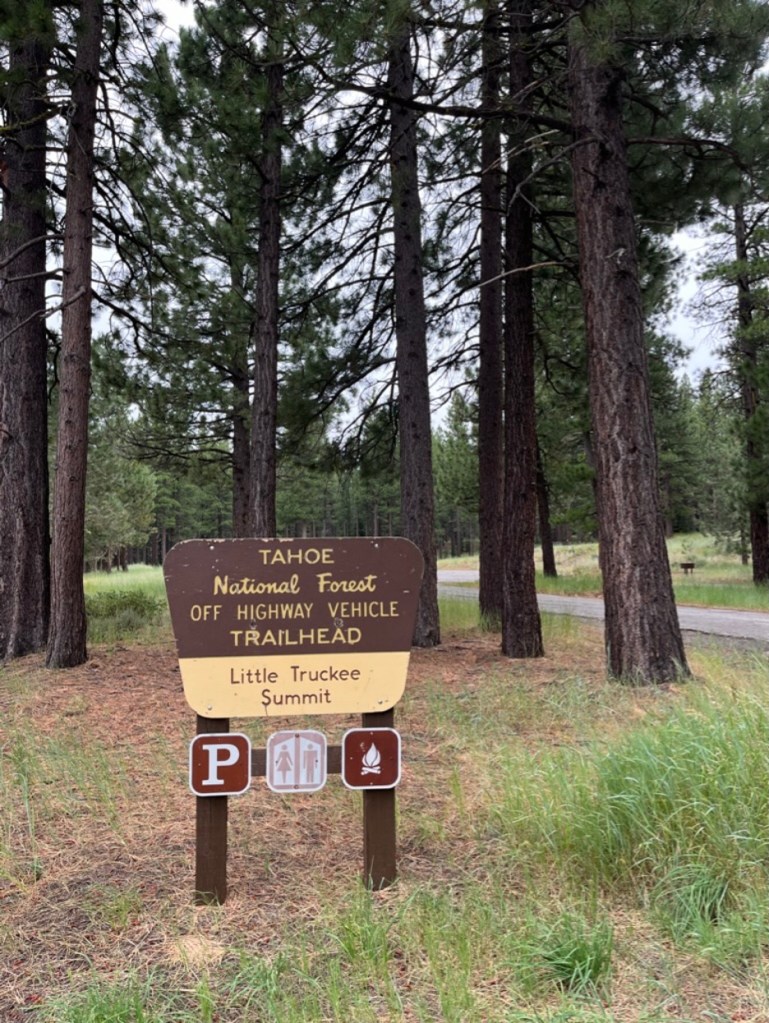
I had been to Little Truckee Summit once before, at my grandmother’s 80th birthday, at the time she said this was the spot her parents had spent their honeymoon. However, reading the memoirs, their camp wasn’t actually at the summit, it was a horseback ride away, at a place called Cold Stream Meadow. Lucky for me, Cold Stream Meadow has a forest service trail right through it, and was designated as protected land by the Truckee Donner Land Trust just a few years ago! (https://www.truckeedonnerlandtrust.org/cold-stream-meadow) My mom and I spent one night at a campground near the summit, then in the morning we made our way out to the trailhead.
We disembarked the train at the Little Truckee Summit and unloaded our meager baggage with unlimited offers of help to carry it to camp which we declined with thanks, company was not needed. The noonday sun was shining down on Cold Stream Meadows, and I pointed out our camp across the little vale with Buck and Cassy dozing lazily about halfway across, listening to abundant bunchgrass breakfast digest. Caching most of our supplies, we started for camp. The horses got up and came to meet us and I presented Cassy to Helen as her wedding present. From then on they were pals.
About then doubt and temerous protoplasm started to infiltrate my body. How was Helen going to react to our perforated tent, our tired stove and burlap convenience station that was at least well ventilated? Before I could panic, we were there. She was so enchanted by Cassy, who immediately recognized her as a soft touch and was mooching everything eatable. She was thrilled with the masses of wildflowers, chipmunks and birds that she didn’t notice the questionable conditions of our castle.
My mom and I started from the Mount Lola Trailhead, and made our way up the trail, which runs roughly along Cold Stream. We wondered what route they would have taken 100 years ago on horseback. There are some old roadbeds in the area that I suspect may be from the logging operations that were active at that time, so perhaps there was a road they could follow. Or maybe they followed the stream, which goes fairly gently upslope and probably was more pleasant than a logging road. The trees along our trial were marked with old-fashioned cut-bark blazes, which are certainly very old, but I doubt they are 100 years old. I am happy to say that 100 years later, this area is still lovely wild land. Even though we were late in the summer, there were still profusions of wildflowers, a great variety of butterflies, and little fat bumblebees everywhere.
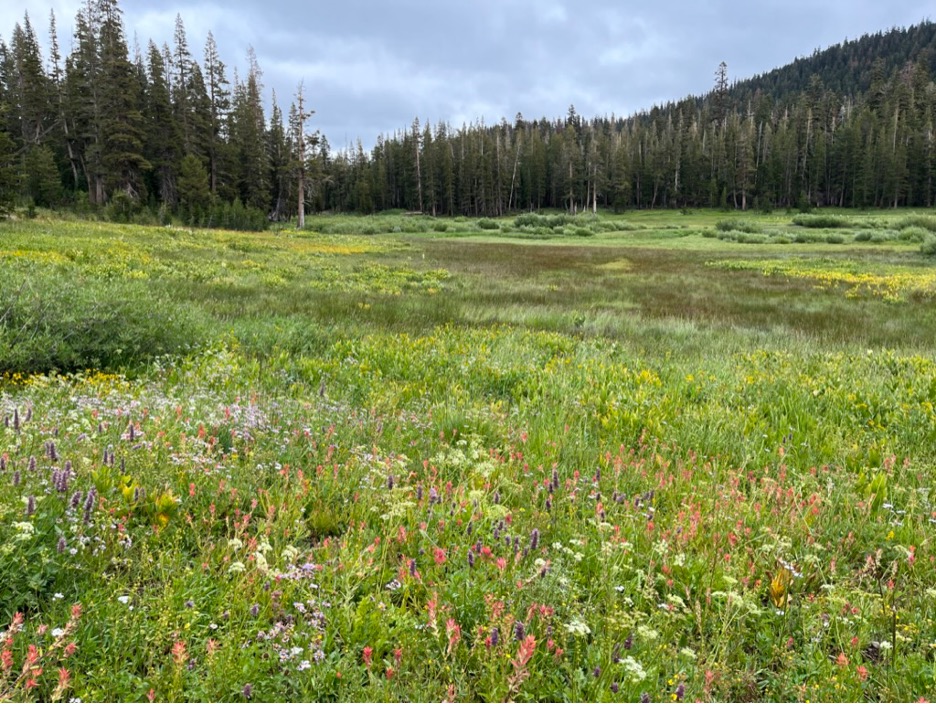
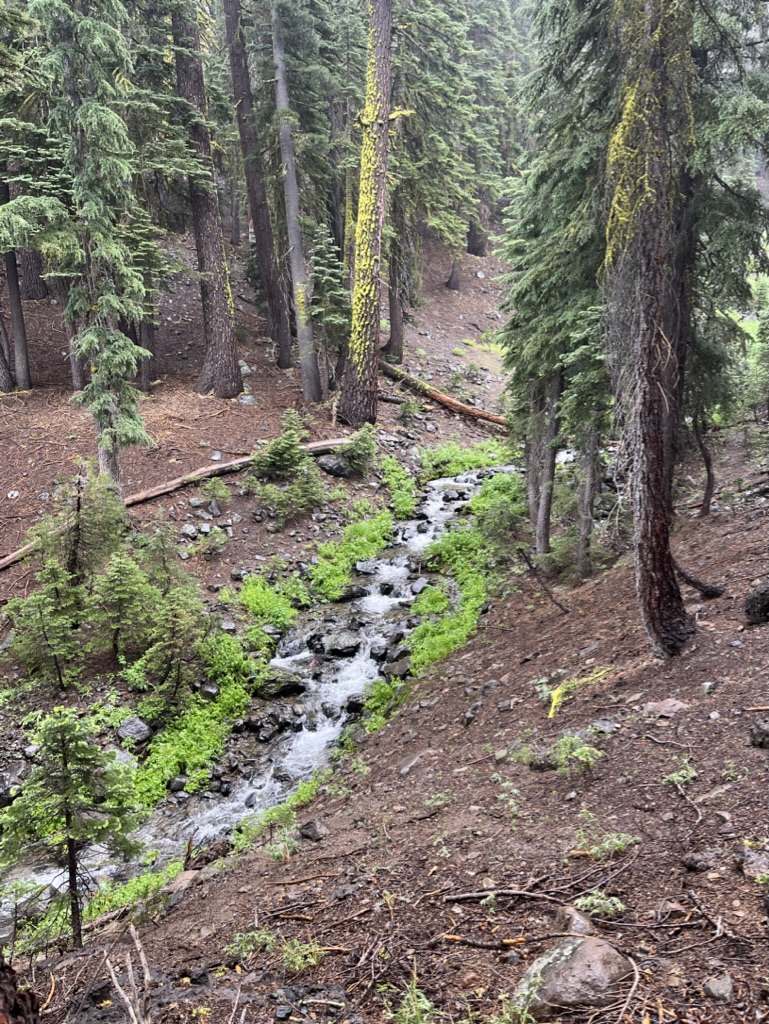
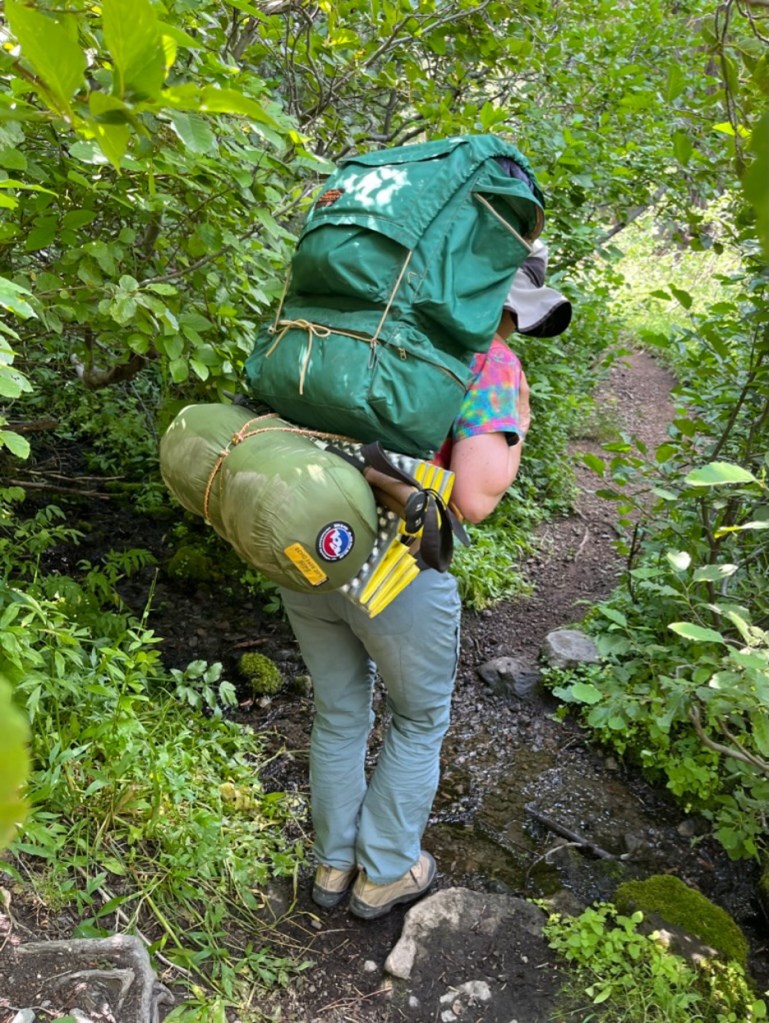
On the second day, after a bit of searching (and a surprise storm), my mom and I found a spot that seems consistent with Lawson’s description. As he detailed, it’s at the far end of the meadow from an old abandoned logging camp, evidenced by a cluster of big old tree stumps cut with old-fashioned tools, and a leveled-out area that probably served as a yard for stacking logs. On the far end of the meadow, we found our spot – credit goes to my mom for spotting the little flat rocky promontory upslope from the trail. It was so small I would have missed it, but it doesn’t take much space to set up a tent, whether it’s 9’x11′ or 10’x12′! As described, there was a little stream running nearby, and a lovely sweeping view of the open meadow. Of course after 100 years of tree growth and erosion we can’t be entirely certain if this was their actual “love nest,” but we were very happy to have found a place that fit the description. We scattered some of my grandmother’s ashes here, and took many pictures. Here are our packs resting in our imagined tent spot:

And the view we imagine they enjoyed from their “love nest:”

Needless to say, our 2023 outdoor gear and skills are a far cry from those of 1923 (more gear, fewer skills). In another post I’ll go into more detail about granddaddy’s very specific instructions for how to create a “bough bed” in the backcountry, I’d like to try it someday. But these days we’ve got waterproof lightweight tents and packs, inflatable sleeping pads and cozy warm sleeping bags. Even my mom’s vintage 1970s pack is very high tech compared to wool blankets, canvas tents, and oilcloth tarps. The only significant downgrade, I suppose, is that rather than having horses to carry all our stuff, we have to carry it ourselves!

We did have a bit of an adventure when a great deal of rain and wind blew in unexpectedly our first night. We had just gotten the tent up and my mom had just crawled into it, when the storm blew in like a wall of wind and ripped all the stakes right out of the ground! Thankfully my mom was in the tent already, so she stayed there and held it in place while I got it back up around her, well reinforced with rocks and tied off to trees. I was absolutely soaking wet by the time I made it back into the tent myself. Here is our little tent weathering the storm:

It sounds like my great-grandparents had similar weather 100 years ago, and I imagine their clothes took much longer to dry!
The last of May and most of June the Sun God and the deities of storm each night cast dice to see who would construct the weather on the morrow. It seemed to us that the Sun God threw “snake eyes” at least three out of five. Most every day it sleeted, snowed, hailed, blew and rained heavily laced with thunder and lightning. For the first week until our tent fly arrived most of our stuff was wet most of the time. How Helen took it, I have often wondered. Nature’s daily routine business that was commonplace to me was a new and exciting pageant to her inquisitive and appreciative mind. She had taken many natural science courses, biology, botany, geology, etc, but had been very little exposed to how these things actually worked: The robin gathering material at our spring for her mud and wattle housing project; the little wren who never heard of family planning, with her mouth crammed full of unlucky insects for her voracious, very vocal siblings; a coyote mousing in the meadow; a doe with spotted fawn bouncing behind her; and the tragic side, a snake with a half swallowed fledgling; a hawk’s swift successful swoop on a careless baby ground squirrel. She never seemed to have time to appreciate and lament the many discomforts she had inherited, but was always bubbling with narrations and questions about her observations of the day.
That same wonder and engagement with the natural world is what keeps me going back to the mountains today. Gratitude to my ancestors, and the generations since, for keeping us connected to these mountains. Here they are in front of the famed 9’x11′ tent:

 Lhbcentennial.com
Leave a comment